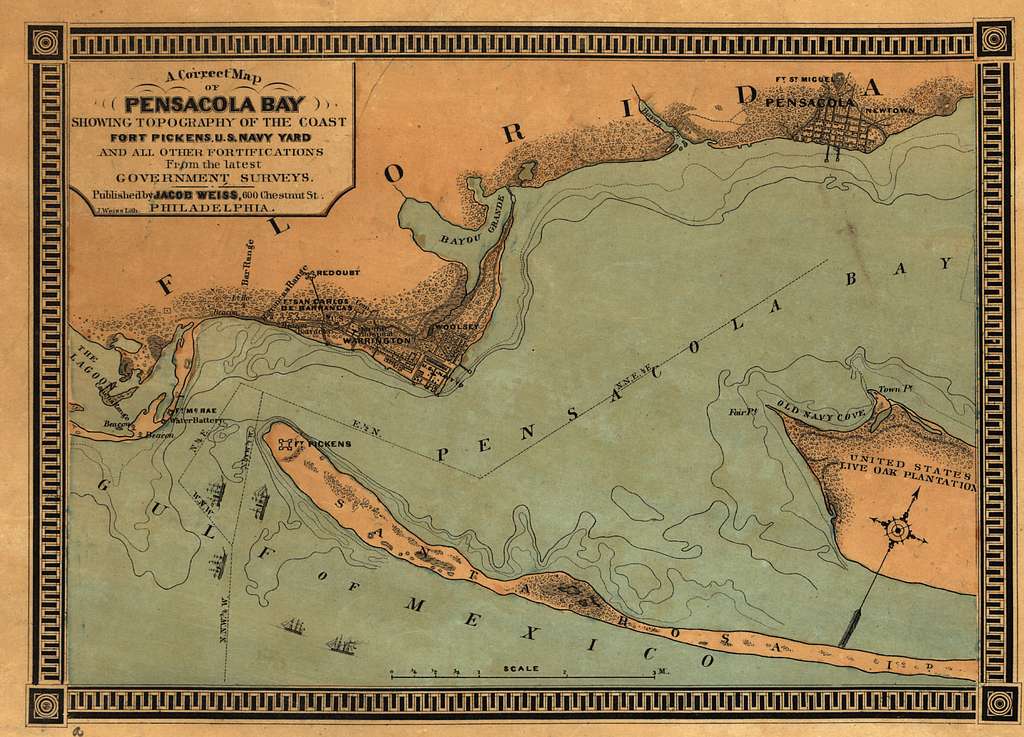
If you drive west out of downtown Pensacola today along Cervantes Street toward Brownsville, you’re passing modern traffic lights, strip centers, and tidy neighborhood cross-streets. Down around the south end of Keys Court, where the headwaters of Bayou Chico once met untamed Florida timber, the blacktop runs smooth.
Two hundred years ago, nobody was driving a paved highway out here. In the sweltering summer of 1826, this high ground was Cantonment Clinch. The United States Army had cut it out of the pines back in 1822—first as Camp Hope, then Camp Brady, and briefly Camp Galvez Spring—as an escape hatch. When yellow fever swept the docks of Pensacola and the stone bastions of Fort Barrancas, Colonel Duncan L. Clinch marched his 4th U.S. Infantry companies out to the freshwater springs to outrun the sickness.
They ran from the fever, but they couldn’t run from the friction of frontier garrison life. Pull up a rocking chair. Pour a tall glass of sweet tea over crushed ice. Let’s step back into the longleaf pine shadows of July 1826… and see what happened when a soldier’s bruised ego collided with the fatal end of a musket.
An Officer the Town Respected
Major Saunders Donoho was not the kind of commander men whispered curses about. At forty-two years old, Donoho was known throughout the territory as a mild-mannered, considerate officer. Born in Caswell County, North Carolina, in 1784—the eldest son of a Revolutionary War officer—he hadn’t started life looking to wear wool and brass. He was an educated gentleman who read law, established a respectable legal practice over in Georgia, and earned a name for steady character.
When the War of 1812 called, he stepped into uniform as an artillery captain. By 1819, he had transferred into the infantry, earning a brevet and eventually his full majority in the 4th U.S. Infantry.
When Donoho arrived in Pensacola, the port embraced him. He was a familiar face in the shipping notices, arriving aboard the schooner Angelina with two companies of troops. Back during the public health crisis of 1822, before the post at Bayou Chico was even fully settled, the town placed Captain Donoho on the civic committee superintending the town’s sanitary police. He wasn’t a remote garrison tyrant; he was part of Pensacola’s civic fabric.
Yet out on the drill field, order was order. And on a military post, liquor and firearms have never mixed well.
The Reprimand and the Tattoo
Friday afternoon, July 7, 1826, was thick with Gulf Coast humidity. On the parade ground at Cantonment Clinch, the regiment was forming up when Sergeant Benjamin Donica appeared in the ranks visibly intoxicated.
Major Donoho handled the infraction by the book. There was no public brutality or excessive display. Donoho removed the sergeant from the ranks, administered a stern verbal reprimand, and ordered Donica back to his quarters to sleep it off. Donica turned on his heel and obeyed. On the surface, the matter was closed.
Around nine o’clock that evening, dusk gave way to complete darkness. Across the parade grounds, the garrison drummers began beating the evening tattoo—the steady, rhythmic drum call signaling the day’s final roll call, commanding soldiers out of the grog stalls and back into their barracks for lights out.
Under the cover of that steady drumbeat, Sergeant Donica walked out of his quarters. He wasn’t heading to roll call. In his hands, he carried an army musket loaded with heavy ball and several buckshot.
Donica crossed the darkened parade ground straight toward Major Donoho. The sergeant stepped within close-quarters distance and asked a terse question: Did the major intend to have him arrested?
Donoho, taken aback by the question in the gloom, asked the sergeant what he meant. He never got his answer. Donica raised the musket to his shoulder and pulled the trigger.
Seventy Minutes in the Pine Shanty
The concussive boom of the discharge cut through the roll of the drums. The heavy lead ball and buckshot tore into Donoho at point-blank range, dropping the major instantly onto the sand.
Fellow officers and soldiers rushed forward, disarming Donica on the spot and slapping irons on his wrists. Donoho was lifted by gentle hands and carried into his quarters. Military doctors gathered by candlelight, but on the 1820s frontier, a close-range torso wound from buck-and-ball was an inescapable death sentence.
For approximately seventy minutes, as his life slipped away, Major Donoho remained completely lucid. He harbored no delirious outbursts. He quietly recounted the encounter to his surrounding brother officers, stating with a clear conscience that in reprimanding the sergeant, he had acted strictly in the fair discharge of his duty.
He didn’t lament his lost career. Looking around the small room at the men he led, Donoho remarked that other soldiers died alone and abandoned on blood-soaked battlefields; he at least had the comfort of passing surrounded by his friends.
His singular, dying regret was the heartbreak the dispatch would bring when it reached his aging mother back home in North Carolina. A little over an hour after the shot was fired, Major Saunders Donoho drew his last breath.
Crape on the Sword Hilts
The next morning, word reached the Pensacola waterfront. The Pensacola Gazette stopped its printing press to set the tragic news in lead type.
At Cantonment Clinch, Colonel Clinch issued a blistering garrison order. He condemned the slaying as a heinous breach of military subordination, laying the blame squarely on the ruinous effects of whiskey. To honor their fallen commander, Clinch ordered all officers of the 1st and 4th Infantry to bind black mourning crape to the hilts of their swords for thirty days.
At four o’clock that Saturday afternoon, July 8, the garrison assembled for Donoho’s burial. Four companies of infantry, commanded by Major David E. Twiggs, formed the escort. The naval band from the USS Constellation joined the post’s musicians, their muffled drums leading the procession.
Behind the pallbearers walked Donoho’s caparisoned horse, led by a servant, its empty stirrups an unyielding frontier military symbol. Attending surgeons, naval officers, and a massive gathering of Pensacola citizens followed the cortege into the pines of Bayou Chico.
Less than three months after arriving at the wharf with two companies of men, Major Donoho was laid in the Florida soil by four.
The Sentence and the Thread of Mercy
The wheels of frontier justice moved deliberately. Nearly eleven months later, in May 1827, Sergeant Benjamin Donica was led into the Superior Court of West Florida to face Judge Henry M. Brackenridge.
The evidence admitted no doubt. Donica was convicted of capital murder. Addressing the prisoner from the bench, Judge Brackenridge admonished him not only as a citizen but as a soldier who had sworn to defend the very officer he gunned down in the dark. The judge sentenced Donica to hang by the neck in a public place near Pensacola on June 20, 1827.
Yet, embedded in the court record was an unexpected turn: the twelve-man jury that convicted Donica appended a formal recommendation of mercy.
Judge Brackenridge informed Donica that a full copy of the proceedings would be forwarded to the territorial governor for review, leaving a thread of hope for executive clemency—though the judge sternly warned the prisoner not to depend on a pardon.
The judge’s words must have been prophetic. On June 20, 1827, Sergeant Benjamin Donica was hanged in public in Escambia County for all to see. The public didn’t get their friend and major back, but they did witness justice.
What remained behind was the stark reality of the military camp: a respected officer dead over a drunken reprimand, and a regiment wearing mourning crape on the hilts of their sidearms.
Watch the shadows, keep your chin up, and we’ll save a cold glass of sweet tea for you. The streets still whisper.
Discover more from Sweet Tea Murders
Subscribe to get the latest posts sent to your email.