
A Boyhood Memory of the Murder of Theda Moore
When I was a boy, I played Little League baseball for the Masonic Lodge team at Bill Gregory Park.
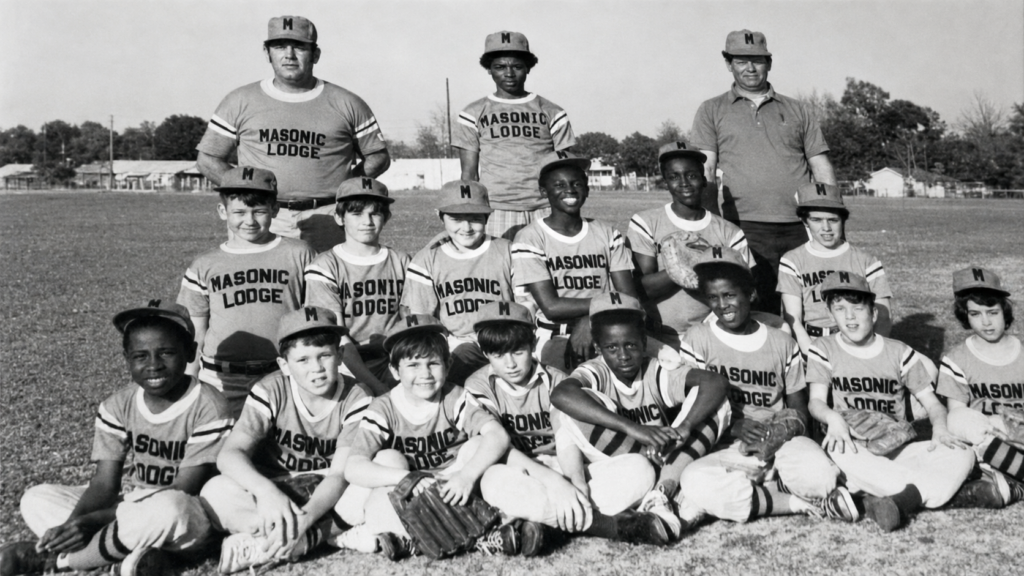
The park sat near the south end of “W” Street, between Navy Boulevard and the Frisco railroad tracks. We were a good team, but what I remember most is that we were all friends—not just the boys wearing the same uniform, but nearly everybody in the league.
We knew one another from school. Most of us were the sons of city or county employees, men who had worked together and known one another for years. Many of the boys were cousins. Pensacola was like that then. Families overlapped. People knew your parents, your grandparents and, sometimes, more about your business than you did.
Our Masonic Lodge team wore orange-and-black uniforms and, let me tell you, we looked sharp…in our minds!
The saying goes that the shortest distance between two points is a straight line. The shortest route from our modest house on Romana Street to Bill Gregory Park began at the railroad tracks half a block north of our home. From there, we could follow the tracks through the Frisco rail yard, pass beneath the Navy Boulevard viaduct and continue to the ballpark, which sat alongside the same railroad line.
To a boy carrying a baseball glove, it was not a dangerous industrial corridor. It was simply the way to the park.
That was the Pensacola of my childhood.
Children walked through neighborhoods and along railroad tracks without much thought. Freight cars stood in the rail yard. Trains rumbled through the western side of town. The air beneath the viaduct was cooler and darker, and every passing automobile made a hollow thumping sound overhead. Beyond it waited an open ball field, orange-and-black uniforms, friends and baseball.
Then, in September 1971, my father told us not to go that way.
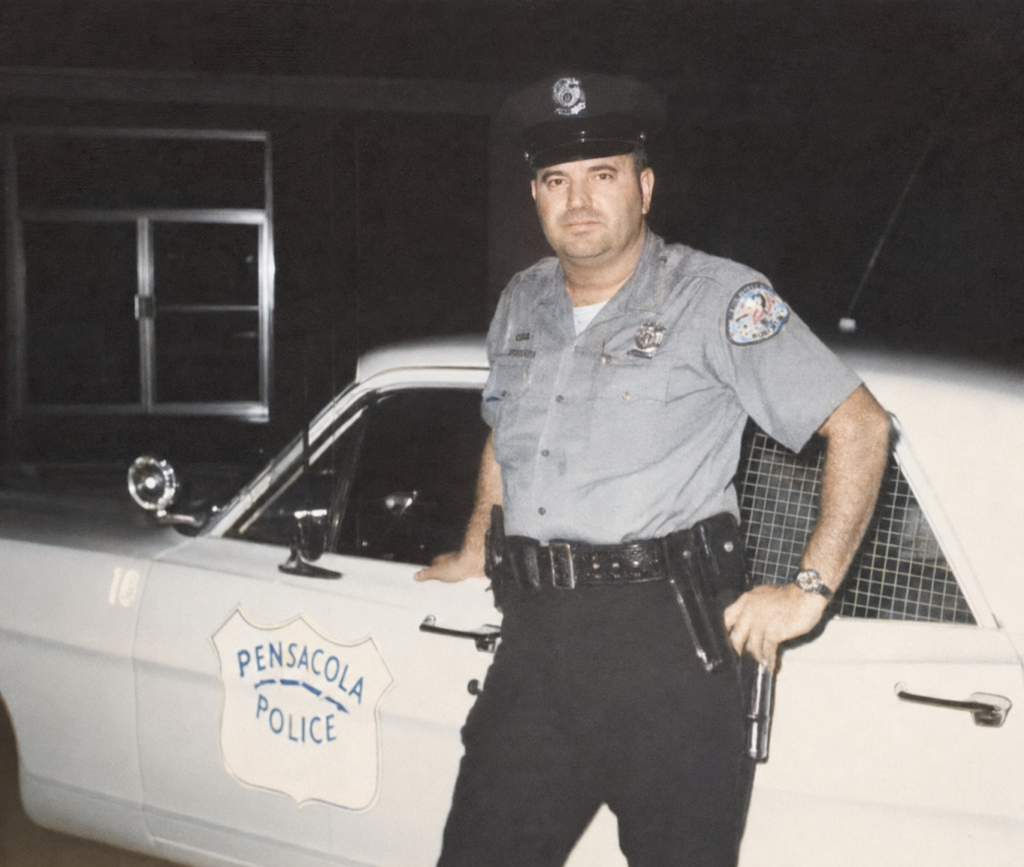
My father, Jim Simmons, was a giant.
At least he was to my siblings and me. Dressed in his Pensacola Police uniform, he seemed like the biggest, toughest police officer who had ever walked the earth. His word was law in our house, and when he forbade us to walk beneath the viaduct, the order was not questioned.
After a few days, we learned why.
A woman’s body had been found beneath the overpass.
I remember the thought that entered my mind:
You mean she might have been lying there, dead, when I walked by?
That possibility was enough for me. I was not going anywhere near that place.
The woman’s name was Theda Elizabeth Moore.
She lived at 2217 West LaRua Street, not in some distant city or in a frightening place that existed only in newspapers, but in our part of Pensacola. She was a native of Laurel Hill, a small community north of Crestview. She had three sisters—Myrtice Kersey and Nettie Cobb of Pensacola, and Cosetta Strickland of Laurel Hill—and two brothers, Troy and Willie Lawrence of Orlando.
She was also a mother.
During the night of Monday, September 27, 1971, something terrible happened to Theda Moore. Investigators believed that she was killed sometime after midnight. She had suffered numerous stab wounds. Her shoes were later found at the top of the embankment, and evidence indicated that her body had been dragged down the slope toward the railroad tracks beneath the viaduct.
She was wearing white slacks and a black blouse.
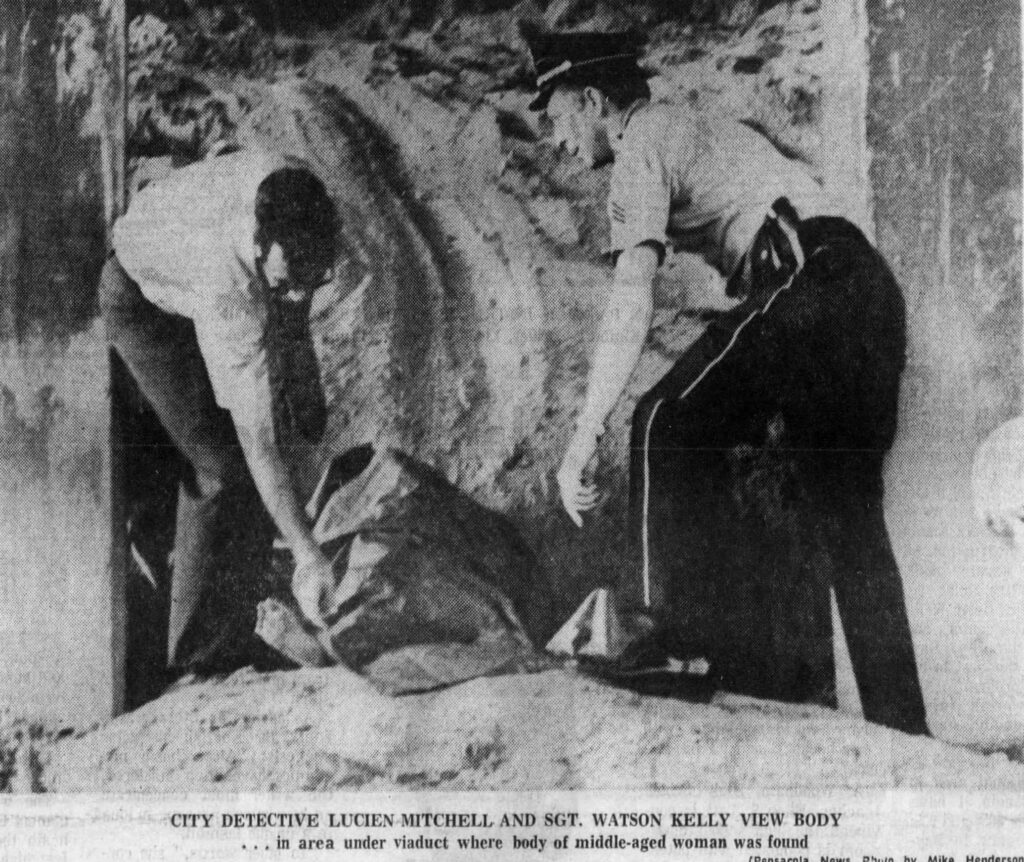
At approximately 7:45 the following morning, two Florida Department of Transportation employees, Edward Lollie and Sherman Nichols, arrived to paint the underside of the overpass. Shortly after beginning work, Lollie saw a woman slumped near the tracks.
He went closer, realized that she appeared to have been stabbed and notified the Pensacola Police Department.
The place immediately changed from an ordinary piece of West Pensacola into a crime scene. Detective Lucien Mitchell and Detective Wendell Rich took charge of the investigation. Police Inspector Aldo Rasponi and Sergeant Watson Kelly were among the officers who responded. An ambulance carried Theda’s body to Sacred Heart Hospital for an autopsy.
Detectives initially had no apparent motive. Robbery and sexual assault were reportedly ruled out. A piece of paper bearing Theda’s name was found near her body, giving investigators a path toward identifying her and finding her family.
Inspector Rasponi and Lieutenant Tommy Suarez went to the Moore home on West LaRua Street at about nine o’clock that morning. They notified Theda’s sister. Her son was not home.
Detective Mitchell returned around eleven o’clock and spoke with Theda’s 18-year-old son, Adrian Ray Moore. He was taken to police headquarters, where Mitchell and Rich questioned him.
By 2:40 that afternoon, he had been charged with first-degree murder.
Police said the young man told them that he had been under the influence of LSD and had experienced a “blackout.” His claim did not answer the most painful questions. It did not explain what took place between a mother and her son that night, why she was attacked or why her body was taken to the viaduct and left beside the railroad tracks.
At his preliminary hearing, Adrian Moore pleaded innocent and requested a jury trial. An Escambia County grand jury subsequently indicted him for first-degree murder.
The case did not go to trial on that charge.
In February 1972, Moore, then 19, appeared before Circuit Judge Ralph McLane and pleaded guilty to manslaughter in his mother’s death. The judge ordered a presentence investigation. On March 15, McLane sentenced Moore to 20 years in prison and recommended that he receive treatment intended to address his drug use. That sentence was ordered to run consecutively to a five-year sentence Moore was already serving for automobile theft.
Theda Moore was buried after a funeral service at First Baptist Church in Laurel Hill, the small Northwest Florida community where her life had begun. The Reverend B. H. McWaters officiated.
The newspapers reduced the case to a series of stark headlines:
Woman Found Beneath Viaduct.
Boy Indicted in Stabbing of Mother.
Plea Accepted in Mother’s Death.
Moore Sentenced to 20 Years.
But a life is always larger than a headline.
Theda Moore was a daughter of Laurel Hill. She was a sister to five siblings. She had a home on West LaRua Street. She was part of the community in which we were growing up—and she died beside a route that neighborhood children used to reach a baseball park.
The story did not entirely end with the 1972 sentence.
Moore was eventually released from prison on parole in September 1979. Five months later, the Pensacola News reported that he had been arrested and accused in connection with the abduction of a young woman. Authorities also linked him through fingerprint evidence to the abductions and sexual assaults of two other women. Those were allegations reported at the time, separate from the crime for which he had already been convicted, but they brought Theda’s name and the horror beneath the viaduct back into the Pensacola newspapers eight years later.
For me, however, the lasting memory is not a courtroom or a newspaper headline.
It is the railroad track behind our house.
It is the route through the Frisco yard, beneath the Navy Boulevard viaduct and onward to Bill Gregory Park. It is the orange-and-black uniform of the Masonic Lodge baseball team. It is the voices of boys who had grown up together, tossing a ball and talking as we walked toward the park.
And it is my father, still a giant in my memory, telling us that we were not to go beneath that viaduct.
At that age, the grown-ups usually protected children from the darkest details. We heard only enough to understand that something awful had happened. Yet the knowledge changed the landscape. A familiar passage became a place to fear. The route that had once represented baseball, friendship and childhood freedom became connected forever to a woman named Theda Moore.
That was real Pensacola.
It was not the Pensacola of postcards and white beaches. It was the Pensacola of railroad yards, modest houses, city employees, police uniforms and Little League baseball. It was a place where children knew one another’s families and walked the tracks to the ballpark. It was a community close enough that a murder beneath a neighborhood viaduct could enter a boy’s imagination and remain there for more than half a century.
Today, roads have changed. Landmarks have disappeared. Generations have come and gone. But beneath the Pensacola we see now lies another city—the one we remember. Sometimes all it takes to uncover it is an old photograph, a yellowed newspaper clipping or the memory of the shortest way home from a baseball park.
Michael Earl Simmons is a retired Pensacola Police Officer and former Homicide detective. He holds the position of Director of the George Stone Criminal Justice Training Center. He is an author of 15 books, an international speaker and police and crime historian. For more information, go to sweetteamurders.com.

Discover more from Sweet Tea Murders
Subscribe to get the latest posts sent to your email.