
At the eastern end of downtown Pensacola, the live oaks of Seville Square reach across the walks until their branches nearly meet. Dry leaves gather along the bricks. Across the street, a white porch railing shows through the trees. Sit on one of the benches long enough, and you can watch the afternoon sun climb the steps of a house.
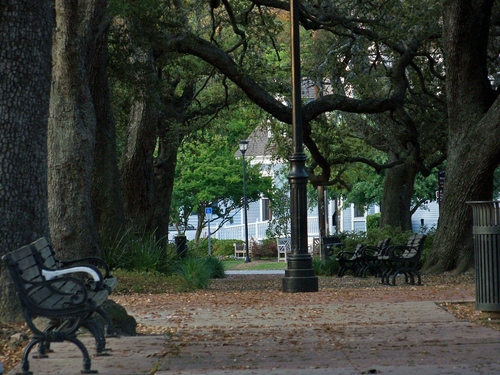
There was a time when the bay came up as far as what we now call Main Street. An old Spanish fort once took up the ground where Seville Square and Plaza Ferdinand lie today. In time, Plaza Ferdinand became the place where Pensacola did its public business. Around Seville Square, more of the old residential neighborhood endured. The square still feels like the front yard of the houses around it.
One Saturday night, around midnight, a young woman was awakened at her home on Government Street by a man who said he was a police officer. His name was Charles Peterson. He showed her a badge and a revolver and told her she had to go with him to the police station.

She dressed and went with him, protesting and asking what she was being arrested for. He would give her no answer. Several blocks from the station, he told her to wait while he tried to “fix it up” so she would stay out of jail. When he came back, he said he had taken care of things. Then he demanded sex in return.
The young woman refused. She told a reporter for The Pensacola Journal that she screamed at the first sign of violence.
That scream is where the story comes out of the dark. Until then, Peterson had been able to make the encounter look like police business. There was a badge, an order to go to the station, and a promise that he could keep her out of jail. He had used the authority people counted on for protection to get her out of her own home. Now her voice carried far enough for someone else to hear.
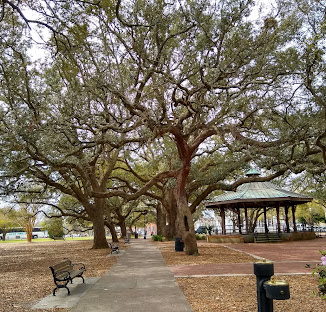
The first account said a resident alerted police to trouble in the park. A later account said a passing sailor heard the woman pleading and reported it. The early report named the officer who answered the call. Desk Sergeant Hoffman sent Archie Bowman to Seville Square, where Bowman arrested Peterson.
Police said the badge had belonged to Peterson’s stepfather, who had once held special police powers. Those powers had been revoked, but the badge had never been turned in. Police said the revolver belonged to the stepfather as well.
The case went from city police court to county authorities, and Peterson was released on a $500 bond. On February 10, 1925, a jury in the Court of Record convicted him of what the newspaper called criminal assault. The first account described an attempted assault. The report at sentencing said Peterson had used the revolver to force the woman to submit. On December 14, Judge C. M. Jones sentenced him to twelve years in state prison. Peterson said he had been drinking. The court held him responsible.
The newspaper reported that Peterson received 12 years in State Prison for his deeds. It left no account of what the young woman’s life was like afterward. She had been asleep in her own home when the man with the badge came for her. Whatever the square had meant to her before that night, it was now also the place where she had to scream for help, which shattered the stillness of the peaceful night and alarmed good people and the police.
Today, from a bench beneath the oaks, you can see how close the houses stand to the square. That closeness is part of what makes it feel so peaceful. It mattered that night, too. Someone was near enough to hear her.
Most people don’t know this story of the shattering of stillness.
But now you do.
Michael Earl Simmons

Discover more from Sweet Tea Murders
Subscribe to get the latest posts sent to your email.