
If a person drives north from Milton, Florida, something wonderful begins to happen. The traffic thins. The buildings fall away. The land opens beneath a broad Southern sky, and the road carries you into the rolling countryside of northern Santa Rosa County.
It is not “touristy” like the white beaches along the Gulf. There are no majestic mountains rising in the distance. There are no bright signs telling travelers where to stop and admire the scenery.
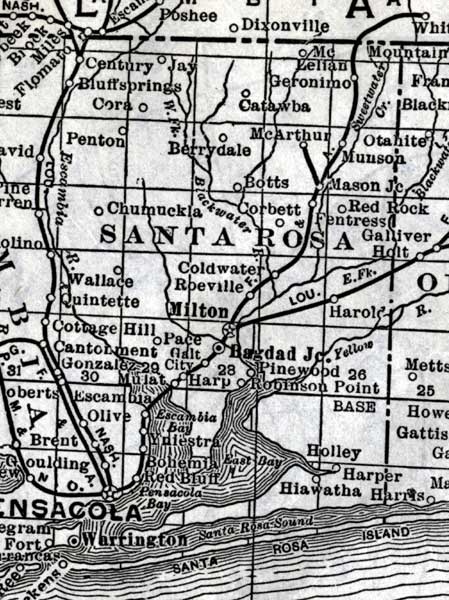
No, it is better. The view is breathtaking. Something that is appreciated, especially by locals. Longleaf pines stand tall against the sky. Creeks wind through shaded bottoms where the air is cool and damp. Fields appear beyond the tree line, and old roads disappear into woods that seem to have been there forever. Roll down the window and take a deep breath, and you can smell the pine, the soil, and the clean country air. You know you have entered northern Santa Rosa County…God’s country.
And the beauty of that country is not found only in its landscape. It is found in its people. They are good people. Honest people. People who still wave when they pass you on a country road and stop to help when they see somebody in trouble. They know their neighbors, remember their families, and take pride in where they come from.
In such a place, a person’s name matters. Your name tells people who your people are. It represents your family, your word, and your standing in the community. Once that name has been stained by gossip or accusation, the damage can be difficult to undo. In the summer of 1889, something was said about a man named Moses Waters. And Waters decided that somebody was going to take it back.
Bad Blood
Moses Waters was no young hothead. According to contemporary newspaper reports, he was somewhere between sixty-five and seventy years old. He had no permanent home and was described as a natural woodsman—a man accustomed to living among the forests and creek bottoms of Northwest Florida.
One newspaper used the old expression that he was “a kind of Bohemian in his habits.” In other words, Waters lived as a wanderer, following his own ways and answering to few people. He also had a reputation for being dangerous.
The man who had offended him was Richard Morgan. The surviving account does not tell us precisely what Morgan said. It tells us only that bad blood developed between the men because of something Morgan had said “concerning” Waters.
But, whatever those words were, Moses Waters believed they had injured his name. For him, ignoring the insult was apparently not an option. Neither was allowing time to settle it. Waters armed himself with a Winchester rifle. Then he sent word to Richard Morgan that he wanted to meet and settle the dispute. He did not elaborate.
That phrase—settle the dispute—could mean many things. Morgan may have believed Waters wanted an explanation, an apology, or a face-to-face reckoning between two men. The newspaper later suggested that Morgan did not understand that he was being summoned to his own execution.
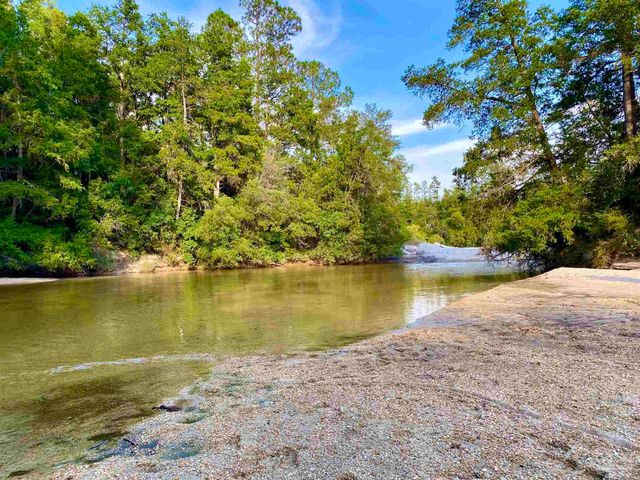
The meeting place was Crow Bridge, where the road crossed Coldwater Creek, approximately eighteen miles north of Milton. It was in the middle of the woods. No one to bother them, but…no witnesses either.
It would have been a lonely place in 1889. No traffic humming along a paved highway. No houses crowded against the roadside: only the bridge, the creek, and the thick woods of northern Santa Rosa County. And somewhere near that bridge, Moses Waters waited with a Winchester rifle.
The Meeting at Crow Bridge
On Monday, June 10, Richard Morgan went to meet him. We do not know whether Morgan arrived on horseback, in a wagon or on foot. We do not know whether anyone accompanied him for part of the journey. Nor do we know what thoughts passed through his mind as he approached Crow Bridge.
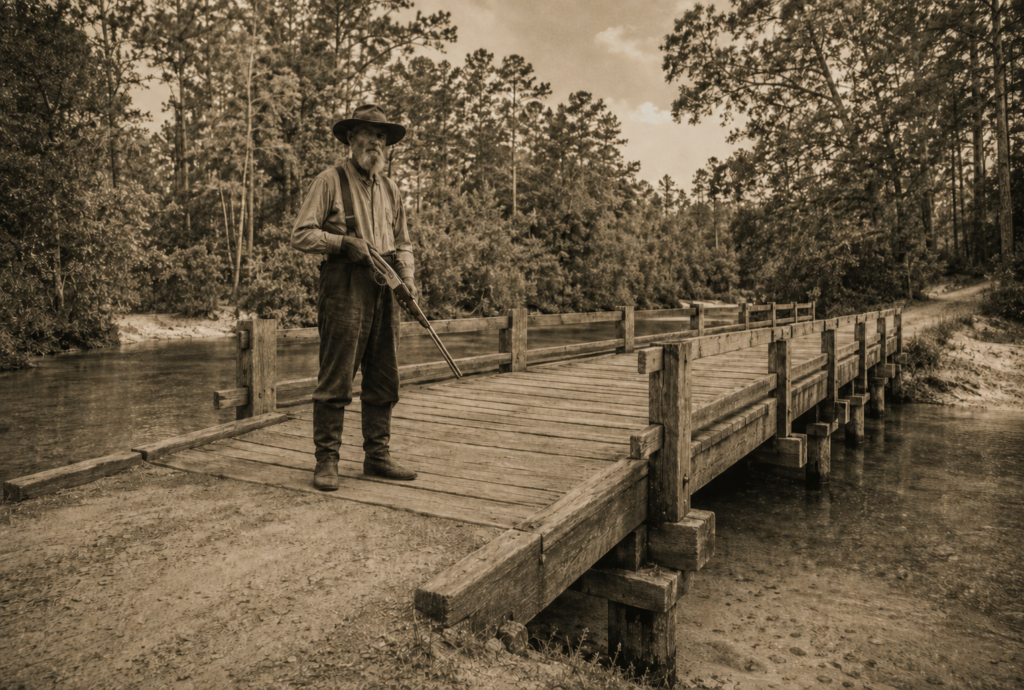
Moses Waters on Crow Bridge (AI – generated image)
Perhaps he believed he could reason with Waters. Perhaps he intended to explain what he had said. Perhaps he thought the entire quarrel had grown beyond its importance and could be put to rest with a few carefully chosen words. But once the men met, Waters demanded a retraction. He wanted Morgan to take back what he had said. Morgan refused.
There is power in such a refusal. In a community where a man’s word was tied closely to his character, retracting the statement might have meant admitting that it was false—or admitting that he had been frightened into silence.
Morgan stood by his words. Waters raised the Winchester. He fired. The bullet struck Richard Morgan in the abdomen, entering approximately two inches from his navel. Morgan died that day on the bridge. Whatever he had said about Moses Waters, he died refusing to take it back.
Into the Woods
After the shooting, Waters disappeared into the country he knew so well. Sheriff Johnson of Santa Rosa County gathered the available information and began the search. But finding an experienced woodsman in the wilderness of Northwest Florida was no simple undertaking.
Waters had no regular home where officers could wait for him. He understood the forests and back roads. At his age, he had probably spent decades learning how to move through the country without being seen.
The first newspaper account reported that Waters remained at large. Because he was a natural woodsman, there were serious doubts that he would ever be overtaken. For a time, it must have appeared that the old man had simply vanished among the longleaf pines.
But Moses Waters could not remain hidden forever. He was eventually tracked into Washington County, east of Santa Rosa County. There, the local sheriff overtook and captured him. Waters was turned over to the proper authorities, given a preliminary hearing and returned to Milton.
He was held in the Santa Rosa County jail without bail. The newspapers did not speak gently about the crime. One called it “heinous” and said it had been committed under “the most unmitigating circumstances.” The evidence then available appeared so serious that the paper predicted the people of Santa Rosa County might soon be called upon to witness a hanging. Moses Waters had killed a man because that man would not retract his words. Now a jury would decide whether Waters would pay with his own life.
The Verdict
The case went before the Santa Rosa County Circuit Court in October 1889. Waters was charged with the first-degree murder of Richard Morgan. The basic circumstances were devastating. Waters had armed himself beforehand. He had summoned Morgan to a remote meeting place. He had demanded a retraction and, when Morgan refused, shot him with a Winchester rifle.
This did not resemble a sudden fistfight or an impulsive shooting committed in the heat of an unexpected confrontation. The evidence suggested preparation, deliberation, and purpose.
The jury found Moses Waters guilty of murder in the first degree. But the jurors also recommended him to the mercy of the court, which took the death penalty off the table. Perhaps his advanced age influenced them. Perhaps there were circumstances that never appeared in the short newspaper accounts. Whatever their reasoning, the recommendation spared Waters from the gallows.
On Saturday morning, the judge sentenced Moses Waters to the state penitentiary for life. He had gone to Crow Bridge demanding that another man restore his reputation. Instead, he destroyed it forever.
The Road North
Today, the countryside north of Milton remains beautiful. The pines still rise above the roads. Coldwater Creek still winds through the woods. The land can still make a traveler slow down, lower the window and breathe deeply. The people of northern Santa Rosa County remain proud of their families, their communities and the names handed down to them.
There is nothing wrong with that pride. A good name is worth protecting. But Moses Waters misunderstood what truly gives a name its value. Reputation cannot be defended with a Winchester. Honor cannot be restored by forcing another person into silence.
Richard Morgan would not retract his words. Moses Waters killed him for it. And in the end, history forgot the insult that Waters was so desperate to erase. The newspapers did not preserve what Morgan had said. They preserved only what Moses Waters did about it.
For more stories, go to Sweetteamurders.com, where the tea is sweet, but the stories ain’t!

Discover more from Sweet Tea Murders
Subscribe to get the latest posts sent to your email.
I would like to read more of these stories about Santa Rosa County and receive more to my email and newsletter if there are any
Yes Sir. I will put you on the mailing list.
Thank You so much
Love your stories!!
Thank you!
I enjoy your stories and eould love to read more.
Cindy Criswell
Ms. Criswell, I will place you on our mailing list if you wish.