
In the heart of the Florida Panhandle lies the rural community of Bear Head, named for its location near the head of the creek that flows into Bear Head Pond. It lies six miles west of the heart of Defuniak Springs.

Bear Head is a small, close-knit place—the kind of community where families have known one another for generations. If an unfamiliar visitor arrived asking too many questions, he might quickly hear:
“You ain’t from ’round here, are ya?”
To a passerby, the quiet, spread-out community might seem unremarkable. Longleaf and loblolly pines rise above scrub oaks, while clusters of live oaks form a comfortable canopy over the sandy ground. Spanish moss hangs from the branches like an old man’s beard.
But to those fortunate enough to call Bear Head home, the landscape is beautiful. Its wildflowers and swamp titi can rival the displays of any botanical garden. The surrounding woods and waterways have long provided excellent fishing and hunting.
Bear Head was known for many things—but it was not known for welcoming outsiders.
The Coming of Prohibition
When national Prohibition took effect in 1920, the manufacture, transportation, and sale of intoxicating liquor became illegal throughout the United States.
People had been making homemade spirits for generations, but Prohibition transformed an old rural tradition into a profitable criminal enterprise. Moonshining, bootlegging, and rum-running became household terms.
As the illegal liquor business grew, so did the number of government agents assigned to fight it. These agents were officially known as revenue officers, but throughout the South, most people simply called them “revenooers.” Their job was to locate illegal stills, arrest the operators, and destroy the equipment.
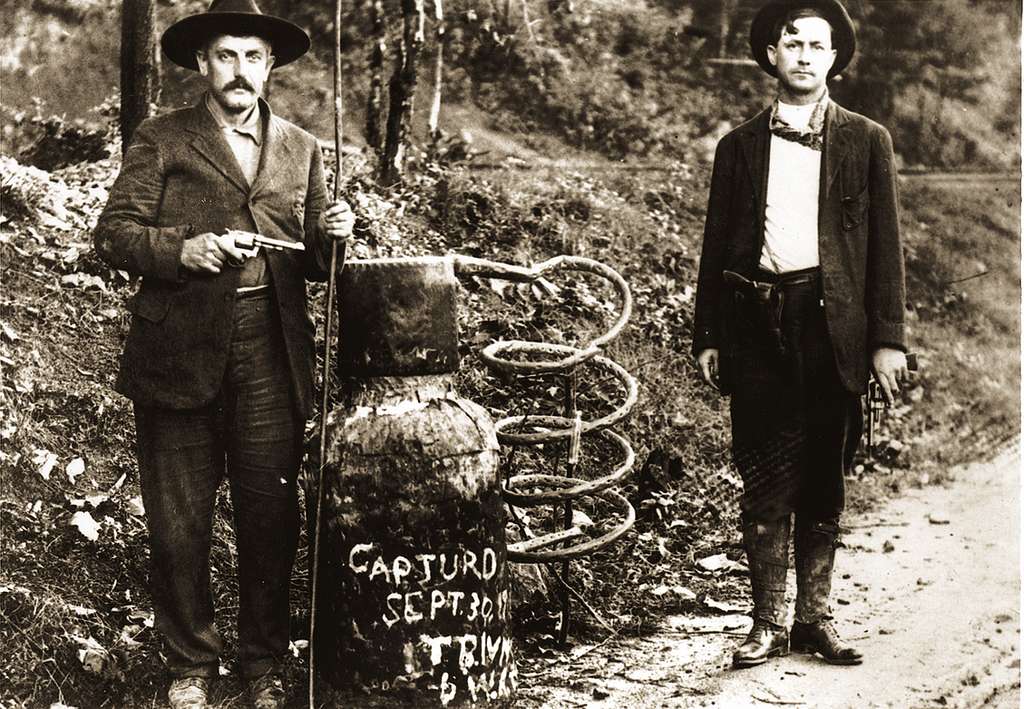
The system worked—sort of. Every still that was destroyed could be replaced. Every arrested moonshiner had relatives, partners, or neighbors willing to continue the operation. In isolated communities, local loyalties often ran deeper than respect for federal law.
A lawman entering those woods was not merely enforcing Prohibition. He was threatening someone’s livelihood—and sometimes walking into a place where nearly everyone knew the danger except him.
Tom Blount of Freeport
About fifteen miles south of DeFuniak Springs, on the northern shore of Choctawhatchee Bay, sits the town of Freeport. Established as a waterfront and fishing settlement around 1830, it was home to James and Becky Blount.
The couple had two daughters when, in 1882, they welcomed their first son, Tom. Another daughter joined the family two years later.
As Tom grew into a young man, he took notice of a good-looking young woman named Katie King. Eventually, he gathered the courage to ask for her hand. They were married on March 24, 1918.
Tom worked as a clerk in a local store, but with five children to support, a clerk’s wages did not go far. In 1929, he secured a position as a deputy sheriff. Part of his new responsibility was to serve as a sort of county revenooer, helping locate and shut down illegal liquor operations. The job offered Tom an opportunity to provide for his family—but it also placed him directly in the path of dangerous men.
The Nowling Brothers
Tom Blount did not know the Nowling brothers. More importantly, they did not consider him one of their own. Tom was not from Bear Head. He was an outsider, a newly appointed deputy who had worn the badge for only a few weeks. He would soon learn about Matthew, William, and Albert Nowling.
Albert was reportedly the leader and the most dangerous of the three. He was believed to be the brains behind an illegal moonshine operation hidden in the Bear Head woods.
In August 1929, authorities decided it was time to raid the still.
Tom had participated in one raid before, but this operation was different. The men suspected of running the still were not merely rural moonshiners trying to earn extra money. The Nowling brothers had a reputation for violence. Still, Tom was ready—and probably excited.
The posse approached quickly and quietly. When the officers descended upon the site, they found one of the stills in operation. They also spotted three men fleeing into the woods. Tom had been a hunter for most of his life. Confident in his ability to read the terrain and follow a trail, he began tracking the suspects.
As he moved deeper into the woods, he caught sight of two members of the gang and gave chase. What Tom did not know was that he was being drawn directly into an ambush. Albert Nowling was concealed in the woods. Tom ran past his hiding place without seeing him. Once the deputy had passed, Albert did not give up. He did not face the deputy and take him on. No, instead, he stepped from concealment and fired a 12-gauge shotgun into Tom’s back. Deputy Tom Blount died where he fell.
A Widow, Five Children, and Twenty Years
The sheriff and the remaining deputies captured all three Nowling brothers.
Matthew and William were later released. Albert was charged with Tom Blount’s murder and brought to trial. The jury found him guilty—not of murder, but of manslaughter. He received a sentence of twenty years in prison. He served only five.
After completing approximately one-quarter of his sentence, Albert Nowling received a conditional pardon and was released. Matthew was free. William was free. Albert was free.
But Katie Blount remained a widow, and five children remained without their father.
The Nowling brothers returned to their lives. Tom Blount never returned to his family.
Deputy Blount had worn the badge for only a few weeks, but the length of his service did not diminish the weight of his sacrifice. He entered the Bear Head woods to enforce the law and was murdered by a man waiting in ambush.
Nearly a century later, the pines still rise over Bear Head. The live oaks still wear their curtains of Spanish moss, and the creeks still wind through the quiet Florida landscape.
But somewhere beneath that peaceful canopy lies the memory of a young deputy, a husband, and a father who went into the woods in August 1929 and never came home.
Rest in peace, Deputy Tom Blount. Your service—and your sacrifice—will not be forgotten.
Michael Earl Simmons
Discover more from Sweet Tea Murders
Subscribe to get the latest posts sent to your email.