
By Michael Earl Simmons
From the “Old Gulf Coast Crime Stories” chronicles, here is a story that highlights the spirit of the Florida Panhandle in its early years. Panhandle Lawmen have always been a breed apart, rooted in the sandy soil, kin to the folks we protect, and tough as the live oaks that line these backroads.
Back in the day, justice wasn’t handed down from some fancy courthouse in Tallahassee; it was forged in the heat of community ties, where every face was familiar, and every grudge could simmer like a pot of grits on the fire. Today, we’re presenting a sorrowful tale from 1935, when Okaloosa County was barely out of its teens, just 20 years old since its birth in 1915, and Laurel Hill stood as one of its bigger outposts, a bustling little hub of loggers, farmers, and families scratching out a living in the shadow of the Great Depression.
Picture it: dusty dirt roads that turned to pavement for the first time around 1930, the scent of pine sap and turpentine hanging heavy in the air, and the Yellow River, just five miles from Laurel Hill, murmuring secrets from its banks, where Scotch settlers first planted roots back in the 1820s. It was a place where lumber mills hummed like angry bees, tung oil farms promised riches, and churches like the Yellow River Baptist, founded way back in 1840, served as the moral compass for folks navigating hard times.
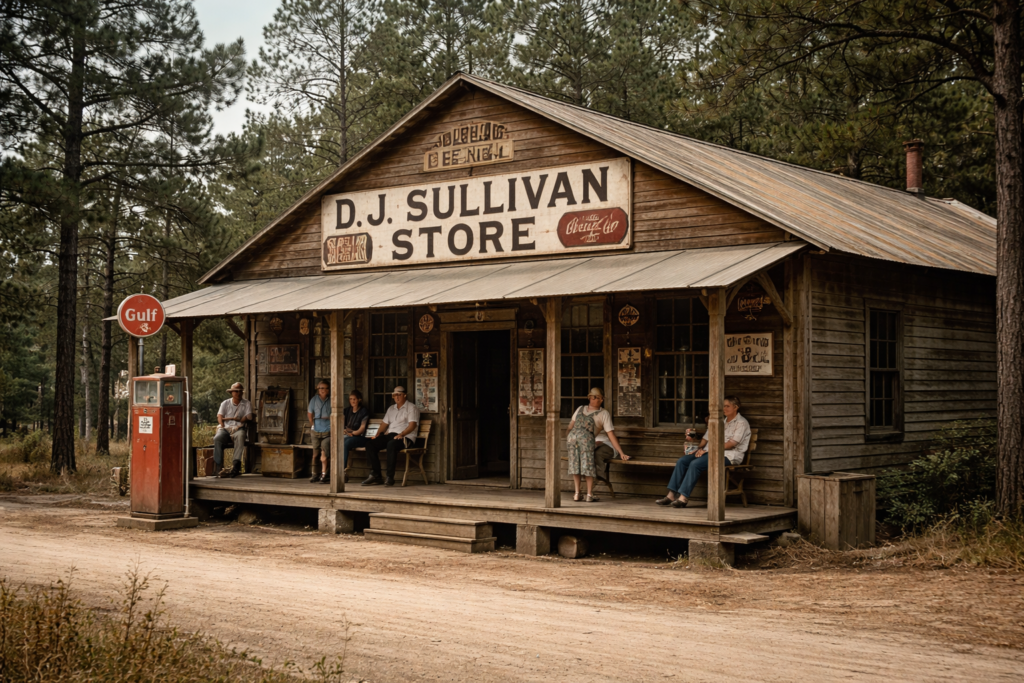
In those days, Laurel Hill wasn’t just a dot on the map; it was a pioneer town, incorporated in 1905 as one of the first in what would become Okaloosa territory. With a population hovering around a few hundred, it thrived on the Yellow River Railroad’s chugging engines hauling timber south to the Gulf, but by the 1930s, the boom had faded. The 1920s land bust had hit hard, closing banks and leaving men desperate. Folks turned to whatever work they could find…watching over stores at night, farming the red clay soil, or tending to family feuds that sometimes boiled over into something uglier. And that’s where our story takes a dark turn, involving a young boy, a disgruntled watchman, and a sheriff who knew every soul in the holler.
The Night the Shots Rang Out: September 14, 1935
It was a Friday evening, ’round 7:30 p.m., when the peace shattered in D.J. Sullivan’s general store right there in the heart of Laurel Hill. Young Jack Davis, just 12 years old and full of that boyish spark – born August 15, 1920, to a local family – was inside making a simple purchase, maybe some candy or flour for his mama. Little did he know, trouble was brewing outside. William Dickinson, a 45-year-old fella from town, had been employed as a night watchman on Sullivan’s properties. But that very day, he’d been fired…discharged for showing up drunk, or so the witnesses later testified. Anger festered quickly in those lean times, and Dickinson, nursing his grudge, walked past the store several times looking in at Sullivan. Finally, he walked up to the front of the store again, and let loose with his pistol, firing four shots into the building.
Two bullets found Sullivan himself, striking him in the chest and abdomen. He survived, thanks to quick treatment over the state line in Florala, Alabama’s hospital—a common trek back then, with the border just a stone’s throw away. But tragedy struck harder with young Jack. A stray round hit him in the forehead and pierced his brain. Down he went, with little hope of ever recovering. But that boy fought like a Panhandle wildcat for his life. For 63 and a half hours – that’s over two and a half days – he clung on at Enzor Hospital in Crestview, slipping in and out of consciousness, his heartbeat steady as a metronome ’til the very end. Dr. O.O. Enzor called it the most remarkable case he’d ever seen; that kid’s will to live was something out of a legend. But on September 17, at 11:37 a.m., Jack Davis breathed his last. He left quite a hole in his family and the tight-knit community.
Now, in the Panhandle Lawmen tradition, they don’t gloss over the human side. Imagine the Davis family’s grief…funeral services held the next morning at 10 a.m., led by Rev. Mr. Eubanks, with the boy’s body laid to rest right in the middle of town, in Almarante Cemetery, where so many Laurel Hill pioneers sleep eternal. Jack wasn’t just a victim; he was a symbol of innocence lost in a world where economic hardship turned neighbors against each other. The Great Depression had folks on edge – jobs scarce, bellies empty, and a firing like Dickinson’s could stem from deeper woes, like the decline of the lumber industry that left men idle and bitter. Was it pure revenge, or a mix of booze and desperation? We lawmen know grudges can fester in small towns, where everyone knows your business, but this crossed into outright recklessness.
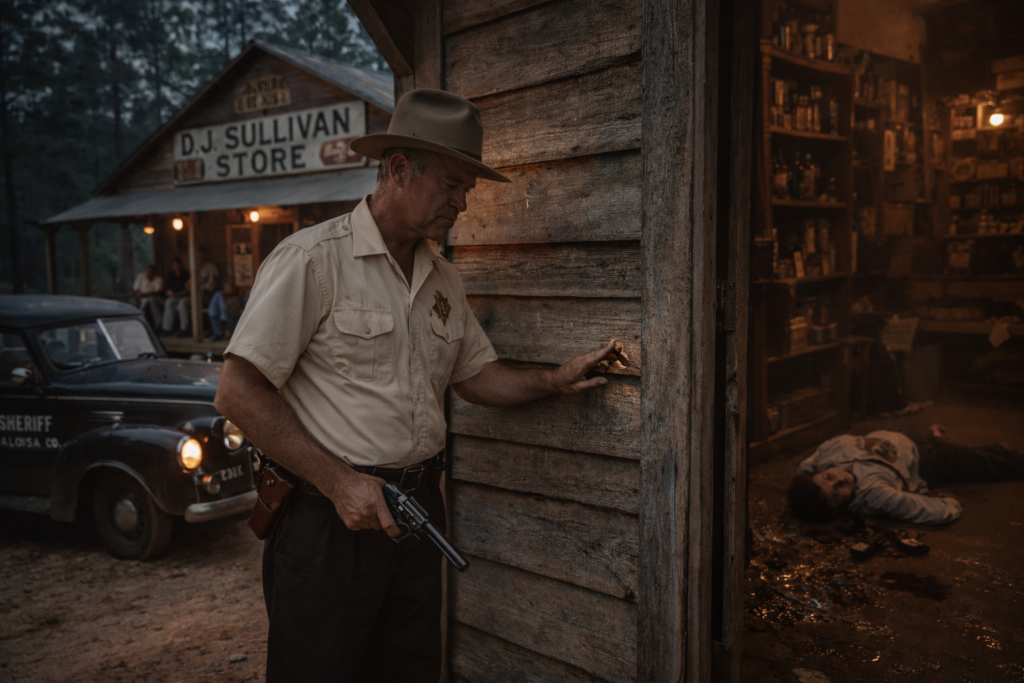
Sheriff Steele Steps In: A Local Lawman’s Dilemma (AI Generated)
Enter Sheriff John P. Steele, a man cut from the cloth of the Panhandle itself. Servin’ from 1933 to 1941, Steele was based out of Crestview, the county seat, but with deep roots in Laurel Hill – the Steele family had been pioneers there since the early days, with kin like J.B. Steele building up the community around 1930. As a lawman from these parts, he likely knew Dickinson, Sullivan, and the Davis clan personally—maybe shared a pew at church or a handshake at the mill. That familiarity cuts both ways: it builds trust, but it weighs heavy when enforcing the law on folks you’ve called friends.
Steele moved swiftly, arresting Dickinson that night and hauling him to the Okaloosa County jail in Crestview. At first, he kept the prisoner’s whereabouts hush-hush, fearing mob violence in a town raw with emotion. Lynchings weren’t unheard of in the 1930s South, especially for crimes against children. But feelings cooled, and justice took its course. A coroner’s jury, led by County Judge Lloyd C. Powell, convened the next morning, viewing the body and adjourning to hear witnesses in Laurel Hill. Steele chalked it up to “family trouble” initially, but as details emerged, it clarified as a workplace spat gone lethal – no blood kin involved, just the volatile mix of employment woes and firearms.
From a lawman’s angle, this case highlights the challenges of policing rural Florida back then. Okaloosa was young, its infrastructure basic. No fancy forensics, just boot leather and community word-of-mouth. Illiteracy hovered around 10.4% in 1930, higher than the state average, meaning many folks relied on oral histories and neighborly bonds rather than written records. Steele’s role wasn’t just enforcer; he was mediator, protector, and sometimes judge of character in a place where the law felt personal.
The Scales of Justice: Trial and Aftermath
By December 16, 1935, the wheels of justice ground to a halt in Crestview’s circuit court. Dickinson, facing a first-degree murder charge, pleaded guilty to the lesser second-degree count; malice aforethought, but not premeditated cold blood. State Attorney E. Dixie Beggs, Jr., accepted the plea, dropping an assault charge on Sullivan as part of the deal. Judge A.G. Campbell handed down 40 years in state prison, a stiff sentence reflecting the community’s outrage over a child’s death.
Nuances here are worth pondering. In the Panhandle way, plea deals like this avoided drawn-out trials that could divide a small town further—witnesses reluctant, families feuding. But it also raises questions: Was justice tempered by sympathy for Dickinson’s hard luck, or pressured by the era’s rough-and-tumble norms? Edge cases abound— what if Dickinson had claimed self-defense, or if alcohol blurred the lines? Implications rippled out: strengthened calls for better employment protections, perhaps, or tighter gun laws in stores, though those came later. For Okaloosa, still finding its feet, this tragedy underscored the fragility of rural peace, where economic slumps could ignite violence.
Reflections from the Badge: Lessons from the Old Days
Looking back through the haze of nearly a century, this Laurel Hill shooting ain’t just a crime story; it’s a window into the soul of the Florida Panhandle. In a county as green as Okaloosa was in ’35, with communities like Laurel Hill transitioning from lumber booms to quieter farming days, lawmen like Steele embodied the bridge between frontier grit and modern order. We honor the fallen, like young Jack, and ponder the what-ifs: better medical care might’ve saved him today, or counseling could’ve cooled Dickinson’s temper. But in the Panhandle Lawmen code, they remember to protect the innocent, hold the guilty accountable, and weave these tales to remind folks that history’s echoes still shape our backroads.
If you’re driving through Laurel Hill today—now a quiet spot with about 500 souls—tip your hat to the old cemetery and think on those who came before.
Stay safe out there.
Confirmed References
- Okaloosa County cemetery records list Jack Davis with a death date of September 17, 1935:
- His burial is recorded at the Almirante Cemetery, an Okaloosa County cemetery, which confirms his identity and the year of death. (RootsWeb)
- Pensacola News Journal article, September 15, 1935: “MERCHANT, BOY SHOT IN STORE AT LAUREL HILL”
- Pensacola News Journal article, September 16, 1935: “YOUTH LIVES WITH BULLET HOLE IN BRAIN”
- Pensacola News Journal article, September 17, 1935: “BOY, BRAIN BULLET-PIERCED, ASKS FOR FOOD, DRINK”
- Pensacola News Journal article, September 18, 1935: “JURY TO PROBE DEATH OF BOY AT LAUREL HILL”
- Pensacola News Journal article, December 9, 1935: “GRAND JURY TO PROBE DEATHS”
- Pensacola News Journal article, December 12, 1935: “LAUREL HILL MAN INDICTED IN BOY’S DEATH”
- Pensacola News Journal article, December 17, 1935: “BOY’S SLAYER GETS 40 YEARS ON GUILTY PLEA”
Contextual / Foundational References
These do not directly mention the 1935 shooting, but they establish the historical setting for Laurel Hill and Okaloosa County: Laurel Hill, Florida: The community was the largest in Okaloosa County prior to World War I and remained an important Panhandle town through the 1930s. (Wikipedia)
Summary of Verifiable Points
- Jack Davis (Aug 15, 1920 – Sep 17, 1935) is listed in Okaloosa County cemetery records, confirming his death at age 12 in late 1935. (RootsWeb)
- Laurel Hill was a key community within Okaloosa County and a major Panhandle locale in the 1930s. (Wikipedia)
Government & Legal Context Sources
- Florida Legislature. (1915). Chapter 6937, Laws of Florida (Creation of Okaloosa County). Tallahassee, FL. Establishes Okaloosa County’s formation date and “young county” context.
Local History & Contextual Sources
- Okaloosa County Clerk of Court & Comptroller. (1935). Circuit court criminal records: State of Florida v. William Dickinson (Second-degree murder plea). Crestview, FL.
- Okaloosa County Genealogical Society. (n.d.). Okaloosa County cemetery records [PDF].
https://sites.rootsweb.com/~flocgs/F-cem1.pdf. Confirms death date of Jack Davis (September 17, 1935).
Community & Geographic Context
- Wikipedia contributors. (n.d.). Laurel Hill, Florida. Wikipedia.
https://en.wikipedia.org/wiki/Laurel_Hill,_Florida. Acceptable for general geographic and demographic background, not for case facts.
¹ The initial reporting on the shooting and subsequent coroner’s inquest appeared on the front page of the Pensacola News Journal on September 18, 1935, reflecting the significance of the crime within Okaloosa County at the time.
² Jack Davis survived approximately 63½ hours after being shot, a fact emphasized by attending physicians as medically remarkable for the era (Pensacola News Journal, September 18, 1935).
³ Okaloosa County was created in 1915, making it only twenty years old at the time of the Laurel Hill shooting (Florida Legislature, 1915).
⁴ William Dickinson pleaded guilty to second-degree murder and was sentenced to forty years in state prison, avoiding a first-degree murder trial (Pensacola News Journal, December 16, 1935).
⁵ Cemetery records confirm Jack Davis’s death on September 17, 1935, corroborating contemporary newspaper accounts (Okaloosa County Genealogical Society, n.d.).
Discover more from Sweet Tea Murders
Subscribe to get the latest posts sent to your email.