Two Men Were Dead—and Police Suspected the Fire Had Been Set
In the darkness before dawn on Saturday, January 20, 1940, Pensacola police received a call from the neighborhood around Belmont and Tarragona Streets. There had been trouble at the Belmont Hotel.
The two-story building stood near the Louisville & Nashville Railroad tracks, which ran north and south alongside Tarragona Street. Belmont Street was only a block north of Wright Street and a block south of LaRua. It was an active part of Pensacola—close to the railroad, downtown businesses, boardinghouses, cafés and the nighttime traffic that moved through the city.
At approximately three o’clock that morning, officers arrived at the hotel and found a man named Will Jackson suffering from a stab wound. Jackson was also known as “Greyhound.” The newspaper described him as a familiar figure in police court. Officers arrested his companion, Anne Smith, in connection with the stabbing.
It appeared to be a violent but otherwise familiar police call. Before the morning ended, however, the Belmont Hotel would become the scene of something far more terrible. A few hours after Jackson was stabbed, fire swept through the building. Flames and smoke consumed the two-story hotel as its occupants scrambled to escape. The blaze attracted crowds from the surrounding neighborhood. Five Pensacola fire companies—Numbers 2, 3, 5, 6 and 7—responded to the alarm.
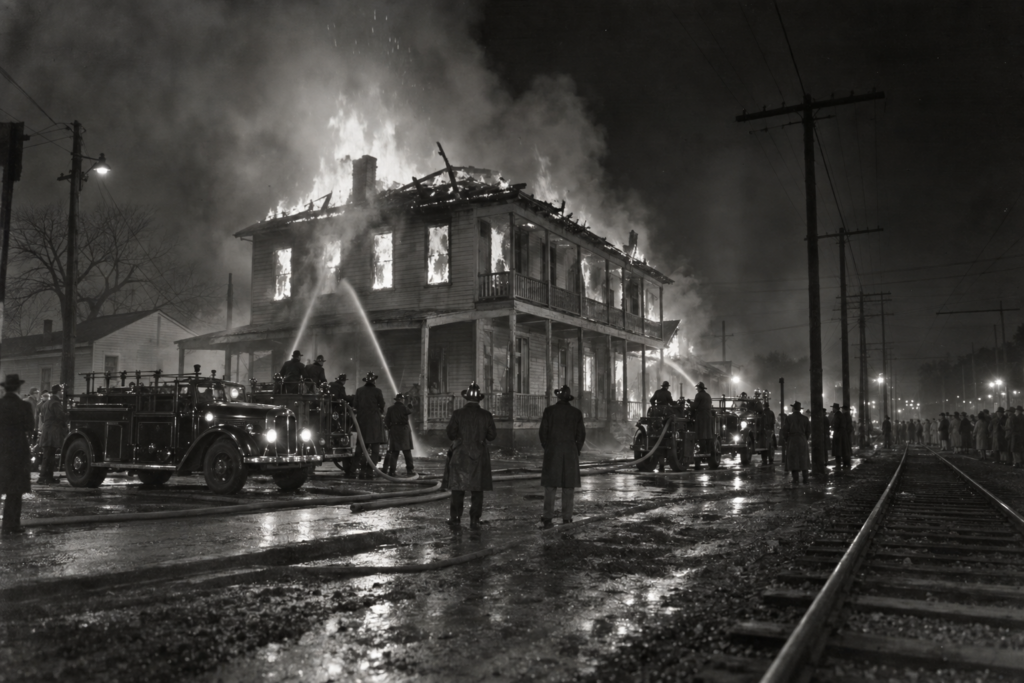
Firefighters battled the flames into the daylight hours. Even at noon, crews were still working among the smoldering remains. Police blocked the surrounding streets, partly to keep the gathering spectators away from fallen or exposed electrical wires.
Sam Peterson, the hotel’s operator, told authorities that all sixteen people known to have been sleeping there had been accounted for. But there was an unsettling possibility: others might have entered the hotel during the night without Peterson’s knowledge.
As firefighters and searchers moved through the ashes, they discovered that two men had not escaped. The bodies were so badly burned that they were described as unrecognizable. They were taken to Benboe’s funeral establishment while police attempted to determine who they were.
Investigators tentatively identified the victims as Henry Franklin and Will Jackson—the same Will “Greyhound” Jackson whom officers had found stabbed only hours earlier. Franklin reportedly worked at a café on South Palafox Street. Jackson’s identification was based partly on the people known to have been inside the hotel and on which occupants could not be located afterward. If that identification was correct, Jackson survived the stabbing but died before morning in the fire.
The timing immediately raised troubling questions. Had the blaze begun accidentally during the confusion following the stabbing? Had someone deliberately set the hotel on fire? And, if it was arson, was the fire connected to the violence that had occurred there earlier?
Police heard reports within Pensacola’s community that two people might have deliberately set fire to the building. Acting on those reports, officers detained Celestine Wynder and Anderson Howard on general charges while they investigated the possibility of arson.
Their detention was not proof that either person started the fire. The surviving newspaper account says only that they were being held on suspicion while investigators continued examining the remains of the hotel. Those remains still had secrets to surrender.
Searchers continued probing the smoldering ashes because authorities feared that additional victims might be hidden beneath the ruins. Peterson believed everyone known to be staying at the hotel had been accounted for—but he could not be certain that only registered or recognized occupants had been inside.
The Belmont Hotel fire therefore presented the police with several mysteries at once. Who stabbed Will Jackson? Did Jackson truly die in the fire, or had the badly burned body been mistakenly identified? How did the blaze begin? And were the stabbing and the fire separate events—or two acts in the same deadly story?
For the people who gathered near Belmont and Tarragona Streets that Saturday morning, all that remained visible was the wreckage: firefighters working through the smoke, police guarding the streets and investigators searching through blackened debris.
Behind them ran the L&N railroad tracks. Around them stood the streets and businesses of a city beginning another day. But inside the ashes of the Belmont Hotel were two dead men, the remnants of a violent night and the possibility that someone had used fire to conceal what happened before dawn.
Whether Celestine Wynder or Anderson Howard was ever formally charged with setting the blaze is not established by the attached account. Nor does the article provide a final determination of the fire’s cause. What it preserves is the beginning of the investigation—and one haunting sequence of events: A stabbing at three o’clock in the morning. A hotel engulfed in flames only hours later. Two bodies burned beyond recognition. And a question left smoldering in the ruins:
Was the Belmont Hotel fire a tragic accident—or had someone wanted the building, and perhaps the evidence inside it, destroyed?
Source note: This account is based on contemporary Pensacola newspaper coverage dated January 21, 1940. The identifications of the victims were described as tentative, and the individuals detained by police were being investigated on suspicion of arson; the article did not establish their guilt.
Discover more from Sweet Tea Murders
Subscribe to get the latest posts sent to your email.