
An elderly Destin widow was found murdered in her bed. Months later, an attorney claimed the man suspected of killing her was helping law enforcement put other people in jail.
On the morning of January 5, 1977, two women arrived at a modest house at 804 Willow Street in Destin.
They had come to pick up their aunt for a trip to Pensacola.
Irma Bell was nearly eighty-six years old, but she had surrendered little of her independence. She lived alone, kept her own house and reportedly still mowed her own grass. According to her niece, Bell did not want to become “an imposition” on her children.
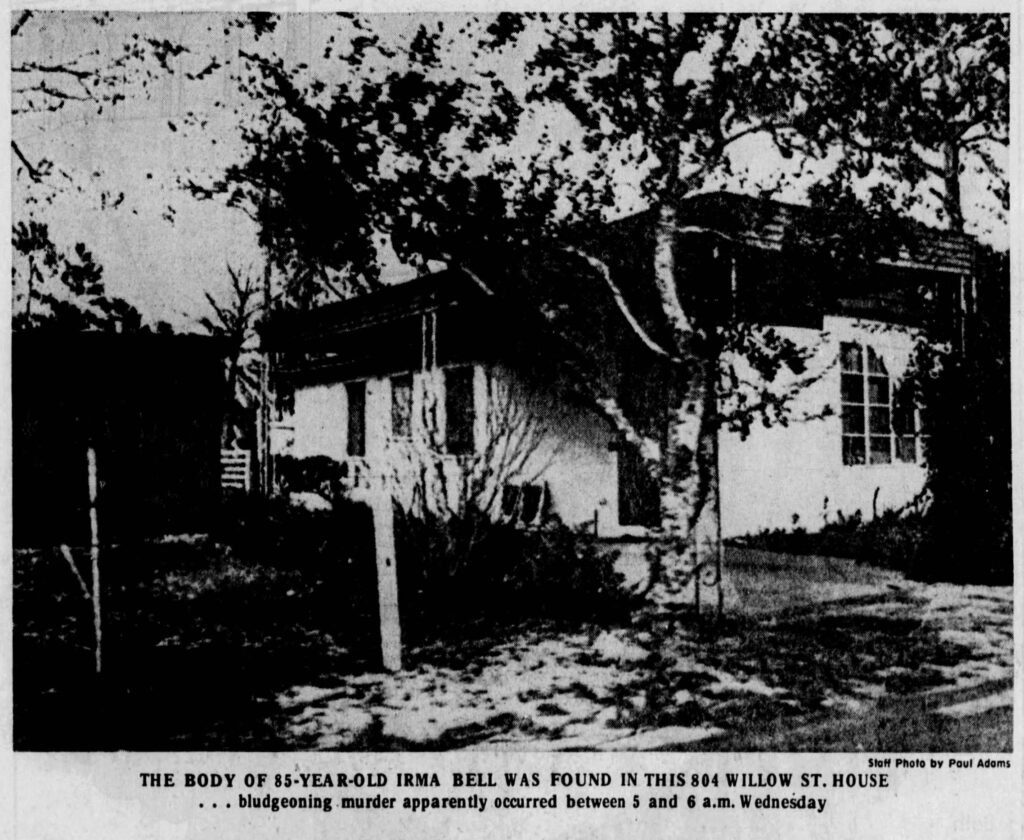
Her nieces expected to find her preparing for the morning’s drive.
Instead, they discovered her dead in bed.
Someone had entered the elderly woman’s home before daylight and beaten her to death.
At first, the crime seemed to offer investigators almost nothing: no obvious robbery, no clear sign of forced entry, no murder weapon and no apparent reason anyone would want Irma Bell dead.
Before the investigation was over, however, the murder of a quiet Destin widow would become entangled with drug investigations, paid informants and accusations that law-enforcement officials were protecting a man who was useful to them.
The central question was no longer merely who killed Irma Bell.
It became whether the man suspected of killing her was helping the very officers responsible for finding her murderer.
A Woman Who Refused to Be a Burden
Irma Bell had moved to Destin during the early 1960s. This was a very different Destin from the crowded resort community familiar to visitors today. Bell lived quietly in a one-story home on Willow Street and maintained a degree of independence that impressed those who knew her.
She had children, grandchildren and other relatives, but continued living by herself. Her decision was apparently deliberate. Bell valued her freedom and did not want her family to feel responsible for caring for her.
That independence made the circumstances of January 5 especially troubling.
Her nieces arrived at the house at about 8:30 that morning. When they tried to enter, they encountered difficulty with the door. After getting inside, they found Bell beneath the covers of her bed.
Investigators believed she had been killed between approximately 5:00 and 6:00 that morning. She had suffered injuries inflicted with what was described as a heavy, rounded object. The weapon was not found.
Nothing obvious appeared to have been stolen. There was no immediate evidence that the killing resulted from a burglary, and investigators could find no clear motive.
Why would anyone enter the home of an elderly widow before dawn and beat her to death?
The absence of an obvious motive suggested something even more unsettling: perhaps the killer had not selected the house at random.
Perhaps Irma Bell knew the person who entered her home.
Fifty Interviews—and Few Answers
The Okaloosa County Sheriff’s Department began interviewing anyone who might have information about Bell’s final hours. Contemporary newspaper reports indicated that investigators spoke with approximately fifty people.
Despite that effort, the case presented serious difficulties.
The exact time of death could not be established with enough precision to eliminate or firmly implicate certain suspects. Investigators had no recovered weapon, no clear sign of forced entry and no readily apparent connection between Bell and anyone who might have wanted her dead.
The case did not disappear, but it stalled.
Then a local attorney made a remarkable public accusation.
His name was David Pascoe, and he claimed he knew who had killed Irma Bell.
The man he accused was Jerry Sylvest.
A Drifter, an Informant and a Suspect
Jerry Sylvest was described in newspaper accounts as a drifter with a criminal record. He was also reportedly working as an informant for law-enforcement agencies conducting narcotics investigations across Northwest Florida.
Sylvest was not merely passing along the occasional rumor. According to contemporary reports, information he supplied had contributed to drug arrests in Okaloosa, Santa Rosa, Escambia and Walton counties. He was said to have been paid by a regional narcotics task force and was considered an important witness in cases against several defendants.
Some accounts credited information associated with Sylvest with helping authorities make dozens of arrests. Other claims placed the number much higher.
That made him a useful man to the law.
It also made him a dangerous enemy to anyone whose arrest or prosecution resulted from his cooperation.
Attorney David Pascoe represented several people against whom Sylvest was expected to testify. That gave Pascoe an obvious reason to examine the informant’s background—and gave Sylvest’s supporters an equally obvious reason to question Pascoe’s accusations.
Pascoe claimed that several people connected Sylvest to Bell’s murder.
According to reports of the attorney’s allegations, two people said they had heard Sylvest admit killing Bell. A woman reportedly claimed that she drove him to 804 Willow Street shortly before the murder. Pascoe also asserted that, while being interviewed in jail, Sylvest had given Bell’s address as his own.
If true, that last detail was particularly strange.
Why would Jerry Sylvest use the address of a murdered woman?
Did he know Irma Bell? Had he stayed at the house? Was the address mistakenly recorded? Or did it indicate a connection that investigators had not adequately explained?
Pascoe believed the information justified a much closer examination of Sylvest. He went further, publicly suggesting that Sylvest’s usefulness as an informant had created a conflict of interest for the officials investigating Bell’s murder.
In other words, Pascoe was asking whether law enforcement could objectively investigate a man who was helping it build numerous other criminal cases.
The Sheriff Answers
Okaloosa County Sheriff Frankie Mills strongly rejected the suggestion that Sylvest was receiving protection.
Mills maintained that his investigators were following every available lead in Bell’s murder. Sylvest’s work as an informant, he said, would not protect him if investigators obtained sufficient evidence connecting him to the crime.
The sheriff also had reason to view the accusations against Sylvest cautiously.
The people making statements about the informant were not necessarily disinterested witnesses. Some were reportedly involved in criminal cases in which Sylvest was cooperating with the prosecution. A person facing prison because of an informant might have a powerful motive to discredit him.
That possibility could not be ignored.
Neither, however, could the allegations.
A woman had been murdered. Witnesses were reportedly making statements that connected a known informant to her house, and at least two people allegedly said they had heard him admit responsibility.
The disagreement soon played out in public through the newspapers. Pascoe accused authorities of failing to pursue the case aggressively because Sylvest was valuable to them. Mills defended his investigators and insisted that no informant was above the law.
Both sides had questions worth asking.
Pascoe’s position carried a built-in conflict: weakening Sylvest’s credibility could help the attorney’s clients.
Law enforcement faced a different conflict: charging Sylvest—or even publicly identifying him as a serious murder suspect—could jeopardize drug prosecutions built upon his information and testimony.
Caught between those interests was the person who mattered most.
Irma Bell.
A Case Lost Among Other Cases
The controversy surrounding Jerry Sylvest reveals the complicated—and sometimes uncomfortable—world of criminal informants.
Law-enforcement agencies often rely upon people who already operate within the criminal world. Informants may have access to information that police officers could never obtain on their own. They can identify dealers, introduce undercover officers and explain relationships hidden from outsiders.
But informants rarely become informants simply out of a sense of civic duty.
Some are paid. Some cooperate to reduce their own criminal exposure. Some seek revenge against rivals. Others may tell investigators what they believe officers want to hear.
The information they provide can be valuable, but the people providing it are not always trustworthy.
That did not make Jerry Sylvest a murderer.
It did mean that his relationship with law enforcement deserved careful scrutiny—particularly after witnesses reportedly connected him to a homicide.
The newspaper stories raised serious questions, but they did not establish Sylvest’s guilt. They do not show that he was indicted, tried or convicted for killing Bell. Nor do they conclusively establish that authorities deliberately protected him.
Pascoe’s allegations remained allegations.
Sheriff Mills’ denials did not solve the murder.
Who Killed Irma Bell?
Nearly half a century later, the most haunting part of the case remains its simplicity.
An elderly woman planned to spend the day with her family. Before her nieces arrived, someone entered her small Willow Street home and killed her in the bed where she slept.
No valuable property appeared to be missing. No murder weapon was recovered. No motive was clearly established.
Then came the accusations, the informant controversy and the public argument between an attorney and a sheriff.
The debate threatened to overshadow the victim.
Irma Bell was more than an address used during a jail interview. She was more than the subject of a dispute between law enforcement and a defense attorney. She was an independent woman who had built a life in old Destin and insisted upon caring for herself for as long as she could.
She did not want to become a burden to her family.
Instead, her family was left with a burden of a different kind: the knowledge that someone had taken her life, and that the questions surrounding her murder might never be answered.
Was Jerry Sylvest falsely accused by people hoping to destroy his credibility?
Was he a violent man whose value as an informant made authorities reluctant to look too closely?
Or did the controversy send attention in the wrong direction while the real killer escaped notice?
The surviving newspaper stories cannot settle those questions.
They leave us instead at 804 Willow Street, before daylight on a January morning, with an elderly widow, a missing weapon and a murder that became entangled in the machinery of other criminal cases.
Someone knew what happened inside Irma Bell’s house.
Whether that truth was overlooked, concealed or simply impossible to prove remains the enduring mystery.
Author’s note: This story is based primarily upon contemporary newspaper reporting. Jerry Sylvest was publicly accused in connection with Irma Bell’s death, but the available articles do not establish that he was charged with or convicted of her murder. Unless additional official records prove otherwise, his involvement should be presented as an allegation rather than an established fact.
About Sweet Tea Murders
Sweet Tea Murders explores the crimes, mysteries and forgotten stories of Pensacola and Northwest Florida. More than a collection of murder stories, it examines the people, places and circumstances behind each case—always with respect for the victims and the communities that still remember them.
Through historical articles, live storytelling events and walking tours, Sweet Tea Murders brings together true crime, local history and the perspective of someone who spent a lifetime in law enforcement. The stories are told without unnecessary gore or sensationalism. The purpose is not to celebrate those who committed terrible crimes, but to remember the lives affected, understand the investigations and preserve stories that might otherwise disappear.
Sweet Tea Murders was created by Michael Earl Simmons, a retired Pensacola Police Department senior sergeant, former homicide investigator and police historian. During his thirty-year career with the Pensacola Police Department, Simmons served in numerous assignments, including Patrol, Tactical, Crimes Against Persons, Training and Neighborhood Policing.
He is the author of more than a dozen books on law enforcement history and true crime, the founder and president of the Pensacola Police Historic Society, and the director of the George Stone Criminal Justice Training Center. His unusual combination of investigative experience, historical research and Southern storytelling allows him to approach these cases from both sides of time: as a detective studying the evidence and as a historian preserving the human story.
To learn more about upcoming Sweet Tea Murders LIVE events, historical walking tours and newly uncovered cases, visit SweetTeaMurders.com.
Sweet Tea Murders with Michael Earl Simmons
Former Homicide Detective • Police Historian
Discover more from Sweet Tea Murders
Subscribe to get the latest posts sent to your email.